EU Capital Markets Union in 2026: Why It Matters for EU Growth
A practical business-focused guide to Europe’s push for deeper capital markets, stronger investment flows, and long-term competitiveness.
In 2026, Capital Markets Union remains one of the European Union’s most important economic projects. Its goal is simple in principle but complex in practice: make it easier for savings and investment capital to flow across borders so companies, infrastructure projects, and innovative businesses can access financing wherever they are located in the EU.
The policy agenda has evolved into the Savings and Investments Union, a broader strategy designed to connect household savings with productive investment, support citizens’ wealth-building opportunities, and help finance strategic priorities such as digital transformation, climate investment, defence capacity, and industrial competitiveness.
Why Capital Markets Union Matters in 2026
Europe has significant savings, but much of that money remains in bank deposits or domestic investment channels. This creates a mismatch: companies need long-term risk capital to grow, innovate, and scale, while savers often have limited access to diversified investment opportunities across the single market.
A deeper capital market can help reduce Europe’s dependence on bank lending, improve financing for small and medium-sized enterprises, strengthen cross-border investment, and make the EU economy more resilient. For businesses, this matters because access to finance often determines whether a promising company can expand, hire, invest in technology, or compete globally.
Capital Markets Union at a Glance
Policy area | Main objective | Why it supports growth |
Market integration | Reduce barriers that make cross-border investment difficult. | Capital can move more efficiently to companies and projects with growth potential. |
Retail investment | Encourage citizens to invest more easily and confidently. | Household savings can be channelled into long-term productive investment. |
Company financing | Expand non-bank funding options for businesses. | SMEs and scale-ups gain alternatives to traditional bank loans. |
Securitisation | Revive safe, transparent securitisation markets. | Banks can free up lending capacity and investors gain access to diversified assets. |
Supervision | Improve consistency in financial market oversight. | More harmonised rules can reduce fragmentation and investor uncertainty. |
Capital Markets Union is not a single law or one-time reform. It is a long-term policy framework that includes regulation, supervision, investor protection, market infrastructure, financial literacy, pensions, savings products, and business financing tools. Its success depends on whether EU and national reforms can make markets simpler, deeper, and more attractive for both investors and companies.
From CMU to the Savings and Investments Union
By 2026, the EU’s capital markets agenda is increasingly discussed through the lens of the Savings and Investments Union. This shift reflects a broader political message: Europe does not only need more capital market plumbing; it needs a system that helps citizens build wealth while giving businesses the financing they need to grow.
The strategy is especially relevant because Europe faces large investment needs in clean technology, digital infrastructure, energy security, defence, innovation, and industrial modernisation. Public budgets alone cannot fund these priorities, so private capital must play a larger role.
Why CMU Matters for Key Stakeholders
Stakeholder | Potential benefit | Practical implication in 2026 |
SMEs and scale-ups | More access to equity, venture capital, bonds, and alternative finance. | Growth companies may rely less on local bank lending. |
Large companies | Deeper bond and equity markets across Europe. | Corporate funding strategies can become more diversified. |
Households | More investment options and potential long-term returns. | Financial literacy and investor protection become more important. |
Banks | More ways to distribute risk and support lending capacity. | Securitisation and market-based finance can complement bank balance sheets. |
EU economy | Stronger investment flows, resilience, and competitiveness. | Capital can support innovation, jobs, productivity, and strategic autonomy. |
Key Priorities for Businesses and Policymakers
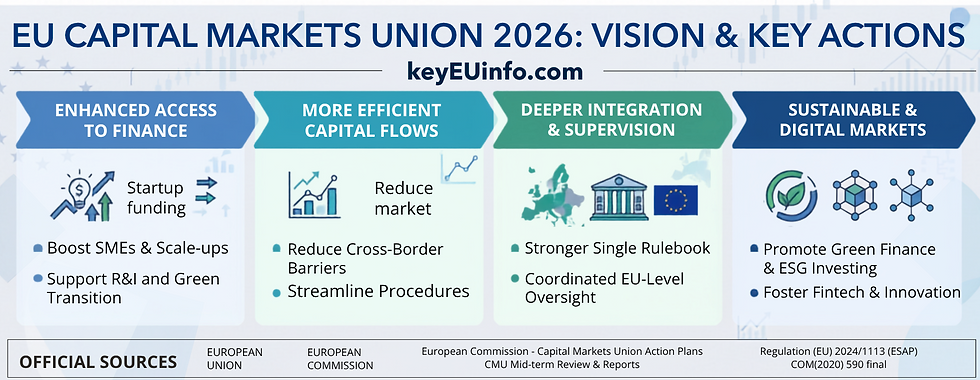
· Reduce legal, tax, insolvency, and supervisory barriers that discourage cross-border investment.
· Improve access to equity and venture capital for innovative companies and scale-ups.
· Strengthen retail investor confidence through better financial literacy and clearer investment products.
· Develop deeper bond, securitisation, and private capital markets across the EU.
· Make listing and capital raising easier for companies without weakening investor protection.
· Support more consistent supervision so investors face fewer fragmented national rules.
· Connect savings to strategic EU priorities such as technology, climate investment, infrastructure, and defence.
What This Means for EU Growth
Capital Markets Union matters because growth depends on productive investment. If companies cannot access patient capital, Europe risks losing promising technologies, innovative start-ups, and strategic industries to deeper markets elsewhere. Better capital markets can help European firms scale inside Europe instead of seeking funding or listing outside the EU.
For finance leaders, the practical message is clear: capital market reform is not only a Brussels policy topic. It influences funding options, investor relations, treasury strategy, valuations, acquisition capacity, and the long-term competitiveness of European business models.
Challenges to Watch in 2026
The biggest challenge is fragmentation. Differences in national rules, tax treatment, insolvency processes, supervision, market practices, and investor behaviour still make Europe less integrated than its economic size would suggest. Political agreement is also difficult because Member States may disagree on how much authority should move from national regulators to EU-level supervision.
Progress in 2026 will depend on whether reforms can balance three goals: stronger cross-border markets, high investor protection, and respect for national legal traditions. Businesses should monitor legislative developments because even gradual reforms can affect funding costs, disclosure obligations, listing decisions, and investor access.
FAQ about EU Capital Markets Union in 2026: Why It Matters for EU Growth
What is Capital Markets Union?
Capital Markets Union is the EU project to create deeper and more integrated capital markets so savings and investments can move more freely across Member States.
Why does CMU matter for economic growth?
It matters because better capital markets can finance innovation, infrastructure, scale-ups, and long-term business investment.
How is the Savings and Investments Union connected to CMU?
The Savings and Investments Union is the newer EU strategy that builds on CMU by linking household savings more directly with productive investment.
Which businesses benefit most from deeper capital markets?
SMEs, scale-ups, innovative companies, infrastructure developers, and larger issuers can all benefit from broader funding options.
What is the main obstacle to CMU?
The main obstacle is market fragmentation caused by differences in national rules, supervision, tax systems, insolvency laws, and investor habits.



Comments