EU Funds in 2026: Why RRF (Recovery and Resilience Facility) Deadlines Matter for Hungary
- viopokhe
- Jun 30
- 4 min read
In 2026, Hungary faces one of the most important EU funding deadlines of the decade. The Recovery and Resilience Facility, or RRF, is entering its final implementation stage, and member states must complete all required milestones and targets by 31 August 2026, submit their final payment request by 30 September 2026, and receive any final payments by 31 December 2026. For Hungary, this matters because a large share of available recovery funding remains linked to reform conditions, governance requirements, investment delivery, and EU assessment procedures.
The RRF is not a traditional reimbursement fund where spending alone unlocks money. It pays out when countries deliver agreed reforms and investments, known as milestones and targets. That makes 2026 a hard operational deadline: Hungary must not only agree plans and pass legal measures, but also produce evidence that the required results have been achieved before the EU’s assessment window closes.
Key 2026 RRF Deadlines for Hungary
Deadline | What must happen | Why it matters for Hungary |
31 August 2026 | All RRF milestones and targets must be completed. | Actions taken after this date cannot be counted for RRF assessment. |
30 September 2026 | Final payment request and supporting evidence must be submitted. | Hungary must provide complete documentation quickly after implementation. |
31 December 2026 | The European Commission must complete final payments. | No RRF payments are expected after 2026. |
Before final payment approval | Hungary must satisfy applicable governance and rule-of-law conditions. | Unresolved conditions can delay or block disbursement. |
Post-2026 period | Audit, reporting, monitoring, and record-keeping obligations continue. | Funds received may still be reviewed for compliance after the programme ends. |
These deadlines create pressure because Hungary has less room for delay than countries that already received a larger share of their RRF allocation. Hungary’s revised recovery plan includes grants and loans for areas such as energy, digitalisation, transport, education, healthcare, green transition, and public administration reform. However, the financial value of those measures depends on execution speed, evidence quality, and the ability to satisfy the EU’s control requirements.
For the Hungarian economy, the difference between unlocking and absorbing funds is significant. Unlocking means the legal and political barriers to payment are removed; absorbing means money reaches projects, contractors, public institutions, households, or businesses. In 2026, both steps must happen under compressed timelines, which increases execution risk for ministries, municipalities, managing authorities, procurement teams, and project beneficiaries.
Financial Impact Areas for Hungary
Impact area | Potential benefit if funds are accessed | Risk if deadlines are missed |
Public investment | More funding for energy, rail, digital, education, and healthcare projects. | Delayed infrastructure upgrades and weaker investment momentum. |
Budget planning | EU funding can reduce pressure on national co-financing and borrowing needs. | More projects may need domestic funding or be postponed. |
Business environment | SMEs and suppliers may benefit from tenders, grants, and modernization projects. | Companies may face fewer public contracts and slower demand. |
Energy transition | REPowerEU-related measures can support energy efficiency and renewables. | Higher exposure to energy-cost volatility and slower green investment. |
Investor confidence | Successful disbursement can improve confidence in Hungary’s EU relations and fiscal outlook. | Missed deadlines may reinforce uncertainty about funding and policy execution. |
The RRF deadlines also affect fiscal policy. If Hungary receives funds on time, the government can support priority investments without relying entirely on domestic borrowing or budget reallocations. If payments are delayed or lost, the state may need to choose between postponing projects, increasing domestic financing, or narrowing the scope of planned investments.
What Hungary Should Prioritise Before the RRF Deadline
· Complete milestone evidence: Each reform and investment should have clear documentation that can survive EU assessment and audit review.
· Focus on achievable projects: Hungary should prioritise measures that can realistically be completed and evidenced before 31 August 2026.
· Strengthen procurement controls: Public tenders must be transparent, competitive, and well documented to avoid later corrections.
· Resolve governance conditions: Rule-of-law, anti-corruption, judicial, and financial-control requirements remain central to unlocking payments.
· Accelerate coordination: Ministries, municipalities, state agencies, and beneficiaries need fast decision-making and escalation routes.
· Plan post-2026 audits: Receiving the money is not the end of the process because monitoring and record-keeping obligations continue.
For companies, the RRF deadline is more than a public-finance issue. Businesses may see opportunities in construction, energy efficiency, digitalisation, consulting, equipment supply, software, transport, and project management. However, companies should also prepare for compressed procurement schedules, documentation-heavy grant conditions, and strict compliance expectations from both Hungarian authorities and EU auditors.
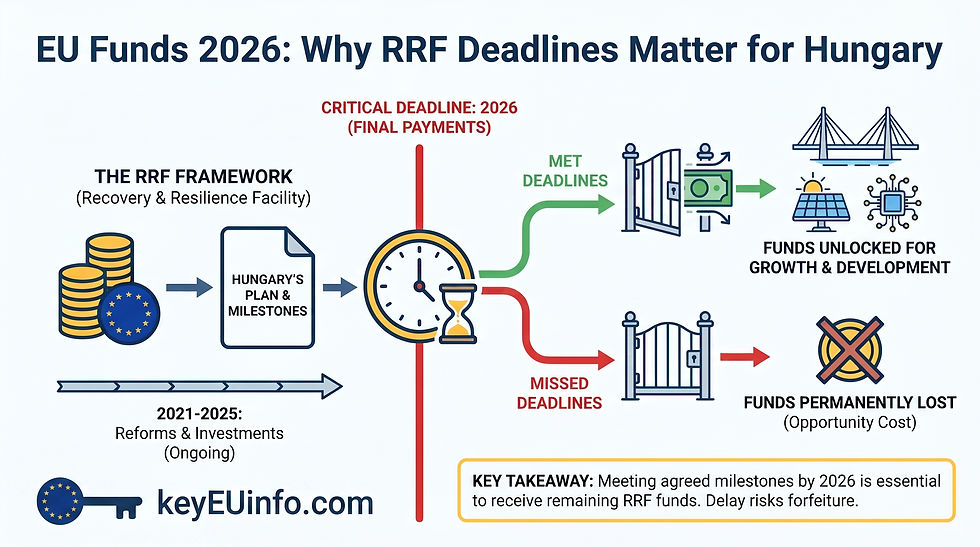
The broader economic impact depends on absorption. If Hungary can convert RRF availability into implemented projects, the funds can support GDP growth, productivity, energy resilience, and public-sector modernization. If deadlines are missed, the cost is not only lost financing but also lost time in upgrading infrastructure and improving long-term competitiveness.
RRF deadlines matter for Hungary because 2026 is the final year to complete milestones, submit payment requests, and receive recovery funding. The key challenge is no longer only political agreement with the EU, but operational delivery: reforms must be implemented, investments completed, evidence submitted, and controls documented in time. For Hungary, successful RRF execution could support investment, fiscal flexibility, and economic confidence; failure to meet the deadlines could leave major funding opportunities unused.
FAQ about EU Funds in 2026: Why RRF (Recovery and Resilience Facility) Deadlines Matter for Hungary
1. What is the RRF? The Recovery and Resilience Facility is the EU’s post-pandemic funding instrument that pays member states for completing agreed reforms and investments.
2. What is the main RRF deadline in 2026? Member states must complete all RRF milestones and targets by 31 August 2026.
3. Why is the deadline important for Hungary? Hungary must meet reform and investment conditions on time to avoid losing access to remaining recovery funds.
4. Can RRF payments be made after 2026? No, the European Commission must make final RRF payments by 31 December 2026.
5. How can businesses benefit from RRF funds? Businesses may benefit through tenders, grants, supplier contracts, energy projects, digitalisation programs, and public investment opportunities.
EU Funds in 2026: Why RRF (Recovery and Resilience Facility) Deadlines Matter for Hungary



Comments