EU Economic Outlook 2026: Slow Growth, Energy Shocks, and Inflation Pressure
The EU economic outlook for 2026 is shaped by slower growth, renewed inflation pressure, and a major energy shock linked to conflict in the Middle East. Official European Commission forecasts show the EU economy still growing, but at a weaker pace, with energy prices, confidence, investment, exports, and public finances all under pressure.
What Is Driving the EU Economic Outlook in 2026?
The central issue is a new energy price shock that has raised inflation expectations and weakened business and consumer sentiment. As a net energy importer, the EU is exposed to higher oil, gas, and refined fuel costs, which can increase household bills, reduce company margins, and redirect income toward energy-exporting economies.
The outlook is not uniformly negative because consumption remains a key growth driver, labour markets are still relatively resilient, and previous investments in energy diversification and lower energy consumption have improved Europe’s ability to absorb shocks. However, the path remains uncertain because inflation, energy supply, financing conditions, geopolitical risk, and external demand can change quickly.
Why the 2026 Outlook Matters for Businesses and Finance Leaders
For companies, the 2026 EU outlook is a planning challenge because slower growth and higher inflation can affect demand, costs, wages, financing, investment, and profitability at the same time. Finance leaders need to model scenarios, protect cash flow, review pricing assumptions, and prepare for policy responses that may affect taxes, subsidies, energy support, and public investment.
· Slower GDP growth means companies may need more conservative revenue, hiring, and investment assumptions.
· Higher energy prices can raise input costs, logistics expenses, household bills, and pressure on industrial competitiveness.
· Inflation pressure can affect wages, pricing strategy, interest rates, and purchasing power.
· Weaker confidence may delay consumer spending, business investment, and cross-border trade decisions.
· Fiscal pressure can increase scrutiny of public spending, energy relief measures, defence investment, and debt sustainability.
Key EU Economic Indicators for 2026
Indicator | 2026 Outlook | Business Meaning |
EU GDP growth | Projected to slow to 1.1% in 2026 | Lower growth may require cautious planning and tighter performance monitoring |
Euro area GDP growth | Projected at 0.9% in 2026 | Companies exposed to euro area demand may need downside scenarios |
EU inflation | Expected to reach 3.1% in 2026 | Pricing, wages, procurement, and cash planning may need frequent review |
Euro area inflation | Projected at 3.0% in 2026 | Monetary policy and financing costs may remain sensitive to inflation data |
Unemployment | Expected to stabilize around 6% | Labour markets remain resilient but hiring and wage planning need caution |
How Energy Shocks Affect the EU Economy
Energy shocks affect the EU economy through several channels, including higher consumer prices, weaker household purchasing power, lower business margins, and more expensive transport and production. They can also increase uncertainty, reduce investment appetite, and force governments to balance targeted relief with already tight fiscal space.
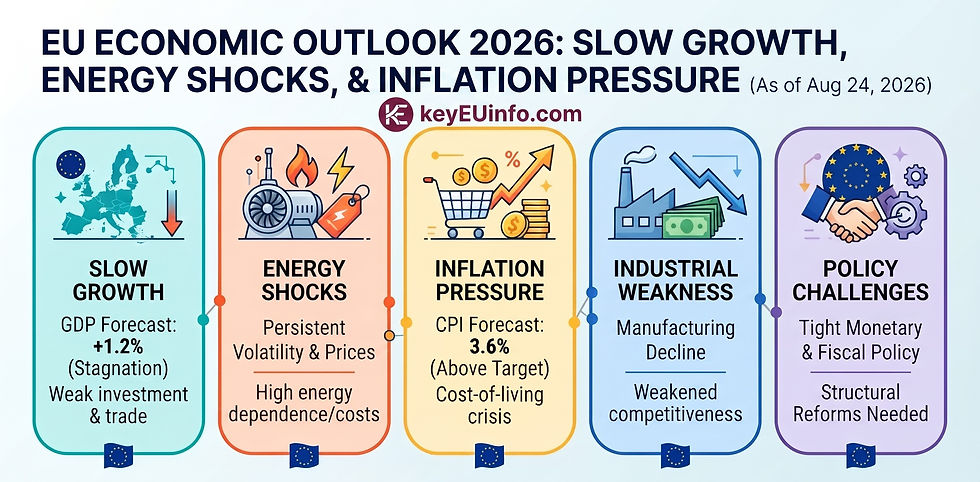
EU institutions emphasize that short-term support should be targeted, temporary, and designed in a way that does not increase overall energy demand. This matters because broad untargeted subsidies can protect consumers in the short run but also increase fiscal costs and weaken incentives to reduce energy dependence.
Risks and Planning Responses for 2026
Risk Area | What Could Happen | Planning Response |
Energy prices | Oil, gas, and fuel prices remain elevated for longer than expected | Build cost scenarios, hedge where appropriate, and review supplier exposure |
Inflation | Higher energy costs feed into food, goods, services, and wage expectations | Update pricing, wage, procurement, and margin assumptions regularly |
Consumer demand | Household purchasing power weakens and confidence remains low | Stress-test sales forecasts and monitor customer affordability |
Investment | Uncertainty, lower profits, and tighter financing slow capital spending | Prioritize projects with clear resilience, productivity, or cash-flow benefits |
Public finances | Higher deficits and support measures limit fiscal flexibility | Track policy changes, subsidy design, tax measures, and public investment plans |
The EU economic outlook for 2026 is defined by resilience under pressure: the economy is still expected to grow, but the combination of energy shocks, inflation, weaker confidence, and fiscal strain makes planning more complex. Businesses that treat the forecast as a scenario-planning signal rather than a single prediction will be better prepared for uncertainty.
n 2026, finance leaders should focus on energy exposure, inflation sensitivity, cash protection, demand resilience, and policy monitoring. Done well, this approach turns a difficult macroeconomic outlook into a practical planning framework for stronger decisions.
FAQ about EU Economic Outlook 2026
What is the main issue in the EU economic outlook for 2026?
The main issue is slower growth combined with renewed inflation pressure caused by a significant energy price shock.
What is the EU GDP growth forecast for 2026?
The European Commission projects EU GDP growth to slow to 1.1% in 2026.
Why is inflation rising again in the EU?
Inflation is rising because higher energy commodity prices are feeding into household bills, business costs, and broader price expectations.
How does the energy shock affect businesses?
The energy shock can raise operating costs, reduce margins, weaken demand, delay investment, and increase planning uncertainty.
What should finance leaders do in response?
Finance leaders should run scenarios, monitor energy and inflation exposure, protect cash flow, update forecasts, and track EU and national policy responses.



Comments