EU Digital Assets in 2026: MiCA, Crypto Regulation, Tokenisation, the Digital Euro and Payment Innovation
Europe’s digital-asset market in 2026 is becoming more institutional, more supervised and more closely connected to mainstream payments and capital markets. MiCA provides greater regulatory clarity, but sustainable growth will depend on consistent supervision, interoperable infrastructure and business models that deliver genuine benefits rather than technology for its own sake.
Why 2026 Is a Defining Year for European Digital Finance
In 2026, Europe’s digital-finance agenda is moving from rulemaking and experimentation into supervised market deployment. MiCA licensing is becoming the operating baseline for crypto-asset service providers, tokenised securities are expanding under existing financial law and the DLT Pilot Regime, and digital-euro work is advancing alongside legislative negotiations.
The strategic issue is no longer whether digital assets will coexist with traditional finance, but how regulated tokens, commercial-bank money, stablecoins and central-bank money will interoperate safely. Firms must therefore combine product innovation with correct asset classification, authorisation, custody, financial-crime controls, operational resilience and credible settlement arrangements.
The EU Digital Asset Landscape at a Glance
Area | 2026 position | Business significance |
Crypto-assets under MiCA | Harmonised rules cover issuers, public offers, crypto-asset services, disclosure, conduct and market integrity for assets outside existing EU financial-services law. | EU-wide scaling becomes more credible, but only with the correct licence, governance and controls. |
Stable coins | Asset-referenced tokens and e-money tokens face issuer, reserve, redemption, governance and supervisory requirements, with significant tokens receiving enhanced oversight. | Payment use cases must address both MiCA and the applicable payment-services framework. |
Tokenised financial instruments | Tokens that qualify as financial instruments remain subject to securities rules, while the DLT Pilot Regime permits controlled experimentation by market infrastructures. | Classification determines the legal perimeter, market infrastructure and investor-protection obligations. |
Digital euro | The project is in a further preparation phase; it is designed as digital central-bank money that would complement cash, not as a cryptocurrency. | Banks, payment providers and merchants should prepare for integration, distribution and new value-added services. |
Payment innovation | Instant payments, wallets, open banking, tokenised deposits and regulated stablecoins are converging into a more programmable landscape. | Competitive advantage will depend on trusted identity, interoperability, fraud controls and low-friction user experience. |
Eight Priorities for Boards, Banks, Fintechs and Investors
· Classify before building: determine whether each token is a MiCA crypto-asset, electronic money, a financial instrument or another regulated product.
· Verify authorisation: confirm that every issuer, custodian, trading venue and service provider has the permissions required in each target market.
· Design for client-asset protection: separate customer assets, define wallet and key controls, and maintain credible recovery and wind-down plans.
· Integrate financial-crime controls: align onboarding, transaction monitoring, sanctions screening, transfer traceability and suspicious-activity reporting.
· Test resilience: treat blockchain nodes, smart contracts, bridges, oracles, cloud providers and wallet technology as critical dependencies.
· Plan the settlement asset: decide whether transactions will use commercial-bank money, tokenised deposits, regulated stablecoins or central-bank money.
· Avoid isolated platforms: prioritise interoperability, common standards and legal certainty across issuance, trading, settlement and custody.
· Track regulatory evolution: monitor the 2026 MiCA review, payment-services reforms, digital-euro legislation and changes to the DLT Pilot Regime.
Crypto Regulation: MiCA Enters Its Supervisory Phase
MiCA created a single rulebook for crypto-assets not already governed by other EU financial-services legislation. In 2026, attention is shifting to consistent authorisation and supervision, staff competence, cross-border business, white papers, complaints, custody, conflicts, market abuse and orderly exit arrangements.
ESMA stated that the final EU transitional period ended on 1 July 2026 and that providers without MiCA authorisation must cease unauthorised EU activity and protect clients during wind-down. The European Commission’s 2026 MiCA review also shows that rules for areas such as DeFi gateways, staking, lending, token classification and multi-issuer stablecoin structures may continue to evolve.
Tokenisation: From Pilot Projects to Market Infrastructure
Tokenisation represents assets or rights as programmable digital tokens, potentially bringing issuance, trading, settlement and asset servicing into a shared digital environment. Its strongest benefits—atomic settlement, automated lifecycle events and broader distribution—depend on legally robust ownership records, reliable cash settlement and interoperable infrastructure.
The EU DLT Pilot Regime provides a controlled route for DLT market infrastructures handling qualifying financial instruments. Europe’s next challenge is scale: fragmented ledgers, limited secondary-market liquidity and the absence of a widely available trusted on-chain settlement asset can reduce the efficiencies tokenisation promises.
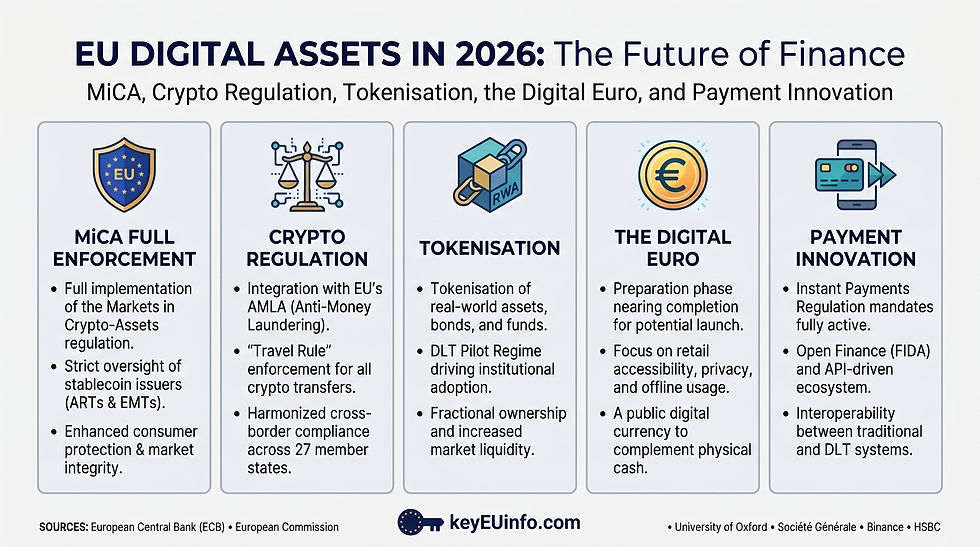
Digital Euro and Payment Innovation
The digital euro would be central-bank money for retail use across the euro area, available alongside physical cash and potentially usable online and offline. It would not be a speculative crypto-asset, and the ECB says potential first issuance could occur during 2029 if the necessary legislation is adopted in 2026.
For payment firms, the opportunity is broader than a new wallet balance. A common public payment rail could support pan-European reach and private-sector innovation, while regulated stablecoins and tokenised deposits may serve different retail, business-to-business, treasury and tokenised-securities use cases.
Choosing the Right Digital-Money or Settlement Model
Model | Issuer and claim | Potential strengths | Key considerations |
Digital euro | Eurosystem central-bank money | Public-money safety, euro-area reach, online and offline potential | Legislation, distribution model, privacy, holding limits and implementation timing |
Tokenised deposit | Claim on a commercial bank | Integration with banking relationships, interest and corporate treasury services | Bank credit risk, interoperability and cross-bank transferability |
MiCA e-money token | Token referencing one official currency, issued under the applicable regime | Programmable transfers and compatibility with some blockchain ecosystems | Reserve, redemption, authorisation, payment-services and distribution requirements |
Asset-referenced token | Token referencing assets, rights or a combination of values | Alternative unit or settlement design for defined ecosystems | Reserve risk, governance, disclosure, redemption and enhanced supervision if significant |
Conventional instant payment | Commercial-bank money transferred through established rails | Mature controls, broad account access and fast euro transfers | Programmability, cross-platform integration and user-experience differentiation |
The likely winners will be organisations that treat regulation, technology and market design as one programme: they will classify assets correctly, protect clients, choose credible forms of digital money and build services that can operate across platforms and borders. The EU’s combination of crypto regulation, tokenisation initiatives, the digital euro and modern payment rails could support a more integrated financial system, provided innovation remains secure, legally sound and
Frequently Asked Questions (FAQ) about Explore the EU digital asset landscape in 2026
Is MiCA fully relevant in 2026?
Yes, MiCA is the core EU regime for in-scope crypto-assets and service providers, with the EU-wide transitional period ending on 1 July 2026.
Does MiCA regulate tokenised shares and bonds?
Not usually, because tokens that qualify as financial instruments remain governed primarily by existing securities law and may use the DLT Pilot Regime.
Is the digital euro a cryptocurrency?
No, it would be central-bank money issued by the Euro system and designed to complement cash.
Will stable coins, tokenised deposits and the digital euro all serve the same purpose?
No, they have different issuers, legal claims, risk profiles and likely use cases, even where their payment functions overlap.
What is the biggest 2026 execution risk?
The biggest risk is launching a product before resolving classification, licensing, custody, financial-crime, resilience and settlement questions.
Explore the EU digital asset landscape in 2026



Comments