EU Competitiveness and Hungary in 2026: Energy Costs, Skills, Capital Access and Industrial Policy Priorities
Competitiveness is not simply about attracting another large factory or subsidising a strategic sector. It depends on whether affordable power, capable workers, scalable finance and predictable policy allow Hungarian companies to innovate, move up value chains and compete across the Single Market.
Why Hungary’s Competitiveness Debate Has Changed
Hungary enters the 2026 EU competitiveness debate with strong manufacturing capabilities, deep integration into European value chains and major new automotive and battery-related capacity. Yet weak investment, energy exposure, skills shortages, regulatory uncertainty and limited financing options for domestic firms constrain the productivity gains those assets could deliver.
The Four Competitiveness Priorities for Hungary
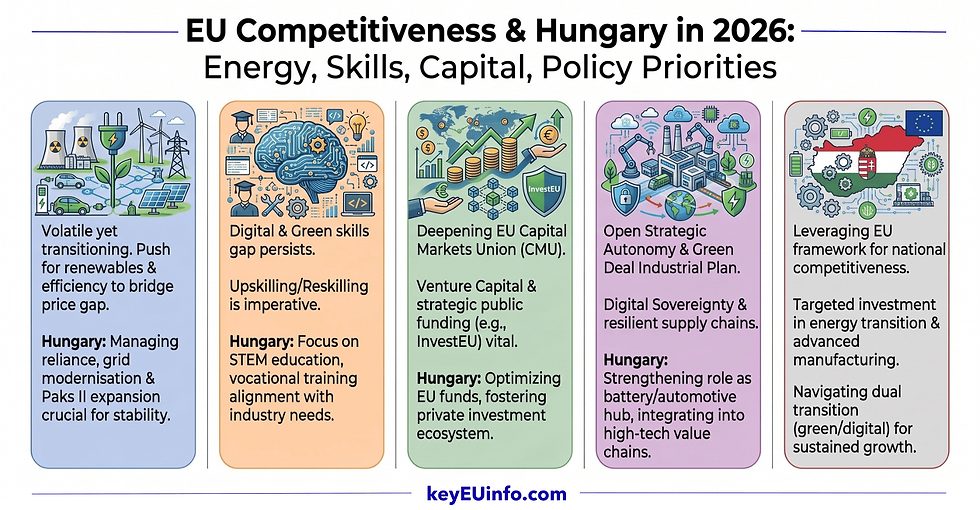
· Lower industrial energy exposure through diversified supply, grid modernisation, renewables, storage, efficiency and stronger regional interconnection.
· Build job-relevant skills in STEM, digital technologies, engineering, management and applied vocational pathways while improving adult reskilling.
· Expand access to equity, venture capital, guarantees and market-based finance so productive SMEs can invest, export and scale.
· Make industrial policy targeted, transparent and conditional on innovation, decarbonisation, supplier development and measurable spillovers.
· Improve regulatory stability, competition, public procurement and access to EU funds to strengthen investor confidence.
Hungary’s 2026 Competitiveness Bottlenecks
Pillar | 2026 challenge | Competitiveness consequence |
Energy | Above-EU-average company electricity prices, fossil-fuel dependence and energy-intensive production increase exposure to shocks. | Margins, investment decisions and export competitiveness weaken. |
Skills | STEM participation, teacher shortages, ageing and mismatches between education and employer demand limit labour supply. | New industrial capacity may not generate its full productivity or local-value potential. |
Capital access | SMEs remain dependent on bank lending and public programmes, while equity and scale-up finance are comparatively shallow. | Innovative domestic firms struggle to commercialise, internationalise and grow. |
Industrial policy | Ad hoc intervention, sectoral distortions and fragmented incentives can weaken competition and policy credibility. | Resources may favour capacity expansion without sufficient innovation spillovers. |
Business environment | Frequent regulatory changes, permitting friction and governance concerns reduce predictability. | Investment is delayed and the cost of capital rises. |
Energy: From Cost Exposure to Productive Advantage
Energy competitiveness requires more than temporary price relief because broad subsidies can weaken fiscal space and delay efficiency investment. Hungary’s durable route is to combine diversified imports with faster grid investment, renewable generation, storage, flexible demand and energy-efficient industrial processes.
For investors, the key metric is increasingly the availability of reliable, lower-carbon electricity at a predictable long-term cost. For policymakers, that makes permitting, connection capacity, cross-border links and well-designed power contracts central components of industrial policy.
Skills: Converting Investment into Hungarian Productivity
Hungary’s industrial strategy will deliver lasting competitiveness only if foreign investment transfers capabilities to local workers and suppliers. Priorities include stronger foundational education, more STEM and technical graduates, modern vocational partnerships, management capability and continuous reskilling for automation and AI-enabled work.
Capital Access: Helping Hungarian Firms Scale
Europe’s fragmented capital markets matter directly for Hungary because domestic SMEs need patient finance for digitalisation, green investment, exports and acquisitions. A stronger Savings and Investments Union, complemented by effective guarantees and competitive local intermediaries, can reduce overreliance on subsidised credit and improve the funding ladder from start-up to scale-up.
A Practical Competitiveness Agenda
Action | Near-term priority | Desired outcome |
Modernise energy systems | Accelerate grids, efficiency, storage, renewables and regional connections. | Lower volatility and improve industrial power availability. |
Align skills and industry | Link curricula, vocational training and adult learning to technology and employer needs. | Higher productivity, mobility and local supplier capability. |
Deepen growth finance | Expand equity, venture, guarantee and export-finance channels. | More Hungarian SMEs scale across the EU. |
Improve industrial incentives | Attach support to R&D, emissions reduction, training and domestic spillovers. | Better value for public money and stronger innovation. |
Stabilise the business environment | Use transparent rules, predictable taxes, competitive procurement and streamlined permits. | Greater investor confidence and stronger private investment. |
Industrial Policy: Target Outcomes, Not Only Inputs
Hungary can use industrial policy to accelerate strategic investment, but support should correct clear market failures rather than protect incumbents or substitute for competition. Transparent selection, expiry dates, performance conditions and independent evaluation can connect public support to innovation, supplier upgrading, skills and decarbonisation.
Hungary’s EU competitiveness opportunity lies in connecting its manufacturing base to cheaper and cleaner energy, stronger human capital, deeper finance and more disciplined policy. Progress on only one pillar will not be enough because each bottleneck reinforces the others.
The finishing principle for 2026 is that competitiveness must be built through productivity, predictability and capability—not through cost advantages or subsidies alone. Hungary will strengthen its place in Europe when investment creates innovative domestic firms, resilient energy systems, transferable skills and scalable sources of capital.
Frequently Asked Questions (FAQ) about EU Competitiveness and Hungary in 2026
What is Hungary’s biggest competitiveness challenge in 2026?
Hungary’s central challenge is turning industrial investment into broad productivity gains despite energy, skills, finance and policy constraints.
Why are energy costs so important for Hungary?
Hungary has energy-intensive industries and substantial import exposure, so price and supply shocks directly affect investment and exports.
How do skills affect industrial competitiveness?
Skills determine whether technology and foreign investment raise local productivity, wages, innovation and supplier capability.
Why does capital-market integration matter for Hungarian SMEs?
Deeper European capital markets can provide more diverse and patient funding for innovation, exports and business expansion.
What makes industrial policy effective?
Effective industrial policy is targeted, transparent, time-limited, competition-aware and tied to measurable productivity and resilience outcomes.



Comments